












You don’t need a gym to build muscle, but you do need something most associate with a gym.
That’s why the question is often asked incorrectly. It’s not about where you train. It’s about what your training actually requires from the body. Many assume that home workout is automatically less effective. Not because they’ve tested it, but because it feels like a “light version” of real training.
The problem is that the body doesn’t care where you are. It doesn’t respond to surroundings, because it only responds to load.
Why many think it doesn’t work
For many, home workout is something you do when you can’t get to the gym. It’s seen as a temporary solution. Something you do a bit of until you can return to “real” training.
That often ties into how you imagine strength training. Big weights, machines and a certain environment. When that isn’t there, it feels like something is missing.
There’s also a widespread idea that the equipment itself creates results. That it’s the barbell or the machine that makes the difference. But it’s not the equipment itself that makes the difference. The crucial factor is whether the muscle is loaded enough for the body to respond.
What actually creates muscle growth
Muscle building requires that the muscle is loaded enough for the body to have a reason to adapt.
It’s not enough just to be active or get your heart rate up. If the resistance is too low, or if the set stops long before the muscle is truly challenged, the stimulus is often too weak to produce change.
In practice, there are especially three things that matter. The muscle must work against real resistance, you must push it far enough in the set for the work to become demanding, and the load must progress over time. If everything feels the same week after week, there is rarely much for the body to respond to.
If you want a more concrete walkthrough of the principles behind muscle building, you can read our article on how to build muscle mass according to science.
That’s also why many can train consistently for a long time without seeing the progress they expect. Not necessarily because they’re doing something completely wrong, but because the training isn’t precise or demanding enough to create gains.
Where it starts to go wrong at home
What often becomes the problem with home workout isn’t the space itself, but how you train in it.
When training at home, it’s easier to hold back without fully noticing. The resistance may not be adjusted enough, rest periods creep out, and the set stops as soon as it starts to bite. You still have the feeling of having trained, but the muscle hasn’t necessarily worked hard enough to cause change.
That’s often where home workout loses its effect. Not because it takes place at home, but because the load and intensity become too imprecise over time.
When home workout actually works
Home workout works when you have the opportunity to make it demanding enough.
In practice, that means the resistance must be high enough that the muscle is actually challenged, and you must be able to adjust the load as you get stronger. If training feels the same week after week, there’s rarely much driving progress.
This is also where many experience that home workout loses effectiveness. Not because it happens at home, but because it becomes difficult to keep training heavy and precise enough over time if the resistance can’t be properly adjusted.
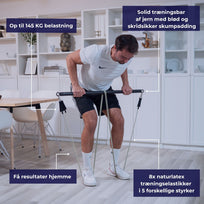
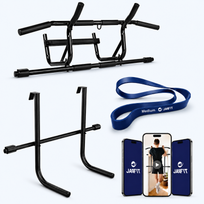
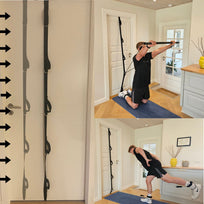
If you can press the muscle close enough to fatigue and gradually make the work harder, you can build muscle mass at home in the same way as in a gym. For many, it’s therefore about having a setup where resistance can be adjusted continually, as with a system like JAAFIT PRO home training set.
The decisive factor is therefore not whether you train at home or in a center. The decisive factor is whether you have a solution that makes it possible to keep the load high enough over time.
This is still the bottleneck
Even if the training itself works, it’s not always enough to create progress.
Many reach a point where they actually train well and regularly, but still don’t really move forward. In that situation it’s easy to believe the problem lies in the program or exercises. Often it has at least as much to do with what the body has to work with outside of training.
If you get too little energy or too little nutrition during the day, it becomes harder to recover and build muscle mass, even if the training itself is sensible. The body can complete the work, but that doesn’t necessarily mean it has the surplus to adapt from it.
You can therefore train seriously at home without seeing the progress you expect if your diet doesn’t follow along.
If you’re unsure how diet should concretely support your training, you can read more in our review of diet and nutrition for strength training. That’s also why training and diet are more closely linked than many assume. One part creates the load, but the other has great significance for whether the body can actually respond to it.
You don’t necessarily lack a gym
It’s easy to think the next step is a better gym, more machines or heavier weights.
For some that may of course be relevant, but in many cases that’s not where the difference is created. The decisive factor is more often whether you have a way to train that is heavy enough, structured enough and realistic enough that you actually do it again and again.
When the load is high enough and training is performed consistently over time, place matters less than many imagine.
That’s why home workout can lead to muscle building. Not because it’s “the same” as a gym in every detail, but because it can give the body the work it needs to develop.




Leave a comment
This site is protected by hCaptcha and the hCaptcha Privacy Policy and Terms of Service apply.